Monday, March 10, 2014

FG should reveal cost of centenary celebration --SERAP

Lagos—Socio-Economic Rights and Accountability Project, SERAP, has requested the Federal Government to make public what it expended on the centenary celebration.

In a statement issued in Lagos, yesterday, by its executive director, Mr. Tokunbo Mumuni,  the non governmental organisation condemned what it called a celebration of corruption by the government for given out “public awards to indicted corrupt public officials, sending a wrong message that amounts to a triumph of corruption over public probity and integrity.”

Besides, SERAP in its statement, supported the Nobel laureate, Professor Wole Soyinka on his rejection of the centenary award, and said that any public award for corrupt people was not portraying the government as ready to battle corruption in Nigeria.
The organisation said: “The award to the late military dictator, Gen. Sani Abacha, considered one of the most corrupt leaders the country ever had, cannot be justified on any ground whatsoever, and in fact send the message that corruption pays.”

PDP wishes defectors well, says 'we can withstand the exodus'

ABUJA—NATIONAL leadership of the Peoples Democratic Party, PDP said yesterday wished the former Vice President, Atiku Ababakar and other party men and women who had left the party to the opposition All Progressives Congress, APC, well saying that it had the capacity to withstand the shock of the vacuum created in the party.Consequently, strong indications have emerged that PDP may not embark on reconciliation missions to unite with Atiku and others who dumped the PDP for the APC.In a statement signed yesterday by PDP National Publicity Secretary, Chief Olisa Metuh, PDP also noted that it was not prepared to join Atiku and the APC in what it termed, politics of mudslinging. “While we concede to the inalienable rights of individuals to associate with any political party of their choice, we advice that they should proffer solutions and alternatives rather than engage in constant condemnation.“The PDP wishes the former Vice President and others well in their chosen enclave but we pray, that someday, they will find it in their hearts space to accord the PDP due recognition for its contributions not only to the development of the country, but also to their individual political progress.“While the PDP recognizes the inalienable right of citizens to hold opinions and identify with political platforms of their choice, we indeed find it very difficult to understand this type of bitterness towards the party even from persons such as Atiku who hugely benefited from the PDP.“However, as the sole custodian of the sacred mandate of over 160 million Nigerians, the PDP will continue to maintain the high moral ground of decency and shall not in any way cheapen this sacred mandate by joining in political mudslinging.“The people are solidly behind President Goodluck Jonathan and his developmental policies and for emphasis, we wish to draw the attention of Atiku and the APC warlords to the achievements of the PDP-led administration.“It is common knowledge that the private sector has been immensely successful in the last two years under the PDP-led administration owing to the continued implementation of our manifesto and policies including the continuation of the PDP ideology of transfer of wealth from public institutions to the private sector.“This is the hallmark of the PDP-led Federal Government wherein hardworking private individuals are now thriving in. manufacturing, trade, commerce and other critical sectors of the economy with business names such as the Dangotes, the Innosons, the AITs, the Channels as well as several others in the banking, telecoms, food processing, hospitality, transport, construction, oil and gas, estate businesses recording huge successes

How far you have to go to make a guitar sound good

     Using differential leakage in two diodes to avoid clicks in the signal path. Some electric guitar players have a whole row of effect pedals (‘stomp boxes’) on the floor in front of them wired in series. Each one has a push-button on it which routes the signal through the effect inside the box, or passes on a clean signal. While these guitarists seem happy with adding lots of distortion when they want it, some are very very fussy indeed about having no distortion when all the boxes are in the ‘straight-through’ position. ‘True bypass’, in the parlance, is gained by having a DPDT switch that disconnects both effect input and effect output, and instead connects the signal to a piece of wire that runs from input to output when the effect is not required. (There is a separate power switch). Robust latching DPDT push-buttons are made for this purpose, but using one doesn’t leave a contact spare to light an LED to indicate which state the effect is in. Triple pole DT switches are available, but are apparently expensive and bulky. To get an LED to work and still switch both ends of the effect with a DPDT switch, someone called RG Keen has used a mosfet, and to bias it correctly with a reliable very high impedance (way over 10M), as well as to protect against static, Keen has used two reverse-biased diodes, one to each rail. One is a signal transistor B-C junction (amazingly low leakage), and one is a gold-doped fast signal diode (more leakage). The difference in leakage sets the gate voltage when the gate is otherwise open-circuit. Not sure I would like to use it in damp conditions, but what a neat idea. There is no circuit here because the copyright status of the images is a little indistinct. But do follow this link and scroll down to the Millenium 2 diagram. The discussion with it takes you through the designer’s

Wireless charger reference designs

Wireless charger reference designs are available from Active-Semi, as well as an evaluation kit, that meets the wireless power consortium WPC 1.1.2 specification. There are two versions: ‘high-performance’ and low-cost’. Powered from 5V, efficiency is said to be up to 75% and stand-by can be as low as 50mW, but these do not take into account the efficiency and stand-by power of mains-to-5V conversion. The firm also has an ac-powered evaluation kit. At the heart of the design is a chip, the PAC5220WP, which integrates an ARM Cortex M0 core, power manager for ac-dc or dc-dc conversion, configurable analogue front-end, data converters, gate-drivers, on-chip temperature sensor, GPIO, and serial ports. EMI performance to FCC Class B is claimed as is meeting CISPR with up to 10dB margin. As well as efficiency, alignment for effective coupling remains an issue with wireless charging – which is inductive, with half the transformer in the charger base and half in the phone. Firmware with the kit includes guided positioning with optional LEDs and buzzer, plus foreign objection detection. In other applications, the same chip can be fed from 5-54V and its external mosfet gate drivers can handle up to 60V for higher power output. “Active-Semi’s PAC5220WP wireless power platform enables scalability beyond 5Vdc input and 5W charging systems to wide-input DC, universal AC inputs, and up to 150W of power delivery,” said the firm. “This enables charging for tablets, ultrabooks, and applications requiring more power. The on-board programmable MCU and the configurable analogue peripherals support multi-mode migration to other standards like PMA.”

Micrel has high sensitivity post amplifer for FTTH networks

Micrel has high sensitivity post amplifer for FTTH networks

7th March 2014
Micrel post amp

Micrel has introduced two limiting post amplifiers for fibre-to-the-home (FTTH) in next generation passive optical networks.

The SY88073L amplifiers are designed for XGPON.2 optical network unit/optical network terminal applications. They can also be used in continuous mode fibre optic or copper cable SFP+ transceiver modules for multi-rate applications from 1G to 12.5Gbit/s supporting 10G Ethernet, Fibre Channel and CPRI/OBSAI data rates.

Both devices offer user selectable LOS or SD status signals and a wide differential input voltage range of 10mVPP to 1800mVPP for extended link distance operation.

Electrical hysteresis of 4dB is provided across a wide LOS/SD threshold range of 4.5mVPP to 30mVPP. For high speed signalling the chips have integrated 50ohm input and output impedances and a CML output with 30ps typical rise/fall times.

A TTL compatible JAM input enables a SQUELCH function by routing back the LOS or SD signal. Other features include selectable RXOUT+ / RXOUT- signal polarity (SY88073L).

“These new devices offer an impressive BER differential sensitivity of 10mV (peak-to-peak) up to 12.5Gbit/s with wide range SD Assert and LOS De-Assert user selectable threshold levels, 4dB of electrical hysteresis, and faster SD Assert and LOS De-Assert timing than competitive continuous mode devices,” said Tom Kapucija, director of marketing for the high speed communications business, Micrel.

Devices have a power supply range of 3.3V +/-10% and come in an industrial temperature range of -40-degC to +85-degC and a 3mm x 3mm, 16 lead QFN package

Black Hat Asia 2014: Dangers of hacking IoT devices

Twenty-six billion devices in the internet-of-things (IoT) may not be wrong but can they be secure?

We all know that computers can be hacked and so three presentations at Black Hat Asia 2014 in Singapore later this month on the dangers of hacking internet-enabled hardware will be of specific interest to anyone developing IoT technology.

It used to be that most of us would only worry about corporate computers being hacked. But as more consumer products increasingly incorporate networking features, that concern should extend to door locks, thermostats, baby monitors.

In Abusing the Internet of Things: Blackouts, Freakouts, and Stakeouts, Nitesh Dhanjani will delve into (and demonstrate) critical vulnerabilities in home automation products.

From spying through a baby monitor to remotely causing a blackout in your home or office building, this talk breaks open an array of high impact attack vectors. What are the security requirements of a next-generation device infrastructure?

In recent times the term, “Trojan horse,” has primarily described disguised malware, but in Building Trojan Hardware at Home, JP Dunning will bring the concept back to the physical arena.

Almost any computer peripheral can be turned into an attack platform and surprisingly you don’t even need advanced hardware expertise to make it happen.

Dunning will showcase his own hardware attack platform dubbed, ‘The Glitch,’ designed to embed into existing hardware, while also covering the threats of modified firmware as a staging point inside corporate networks.

How much do you trust you phone? (If you’re coming to Black Hat, we can take a guess.) The average person is unaware of just how much uniquely identifying information leaks from a smartphone, much less how it can be harnessed for attacks.

The Machines That Betrayed Their Masters will walk you through how Glenn Wilkinson built a resilient, modular, reliable, distributed tracking framework, Snoopy, which has not only expanded into vectors beyond Wi-Fi, but is now airborne via a quadcopter.

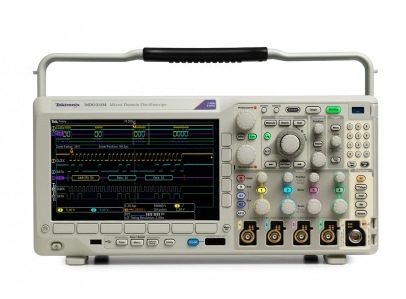
Tektronix combines scope with spectrum analyser in multi-function instrument

Tektronix has introduced a range of mixed domain oscilloscopes which incorporate a spectrum analyser. The same instrument can also be configured with options for a logic analyser, protocol analyser, arbitrary function generator and 4-digit digital voltmeter.

As a result the fully configured the MDO3000 can be a six function instrument.

According to Dave Farrell general manager, Mainstream Oscilloscopes at Tektronix, market research has shown that “25% of scope users use a spectrum analyser multiple times a week”.

The MDO3000 oscilloscope has 2 or 4 analogue input channels with bandwidth ranging from 100MHz to 1GHz, and it incorporates for the first time what Farrell called “an entry-level spectrum analyser”. The spectrum analyser comes as standard with the scope, 9kHz up to the 1GHz bandwidth of the scope.

The RF input frequency on any model can be extended to 3GHz.

The basic scope is the same as the previous MSO/DPO3000 mixed-signal oscilloscope series. It includes 125 trigger combinations, automated serial and parallel bus analysis, Wave Inspector controls and optional automated power measurements round out the feature-set, and ensure comprehensive tools for every stage of debug.

The multi-instrument capability is extended with options for a 50MHz arbitrary function generator with a 128k point waveform memory, 16-channel logic analyser with a 500Msample/s sample rate and 10 million points record length and a protocol analyser.

There are nine optional serial protocol analysis packages – I2C, SPI, RS-232, USB 2.0, CAN, LIN, FlexRay, MIL-STD-1553, and audio.

There is also an integrated digital voltmeter (DVM) provides 4-digit AC RMS, DC, or AC+DC RMS voltage measurements, as well as 5-digit frequency measurements. The DVM comes free when an MDO3000 product is registered with the manufacturer.

Tektronix is also offering for the first time a 3.9pF passive voltage probe for the instrument.

Prices range from £2,250 for the base-level 2-channel scope and spectrum analyser without any options

Hello