Monday, November 03, 2014

IF THE GRASS IS GREENER ON THE OTHER SIDE, CHANGE YOUR GLASSES

Why do we get so caught up in what is happening on the other side of the fence?  The grass is not greener and to believe it is requires a change in how we are viewing the scenery.  In addition to changing our glasses to take in this new view, our attention requires a full turnabout and eyeful of what is going on in our own yard and life.  He or she is not any better than me or you physically or materially and it is important to realize that to green up our own grass, we need to start taking care of it. 


I am zeroing in on comparison being the thief of joy because that is the darn truth.  We will always be at different levels of health, looks, and financial status and that is just how the world works.  The important thing is to make the best out of what we have, celebrate who we are at this moment, and work on becoming a better self than we were yesterday. I refuse to waste my time worrying about someone else's grass and let the weeds infest mine.


I do not have the fanciest house, the most expensive car or clothes, the straightest teeth or legs for that matter, but that is all a part of where I am in life and I am happy with that.  I will never have the butt of a twenty something, a few wrinkles have appeared on my 50+ face, and I have hardware in my neck and again, I accept who I am and can only work on taking care of the body that walks this earth.  I am not saying that it is not OK to dream about wanting something because that can be a goal and is fun to think about.  What robs the very life out of a person is becoming jealous and bitter because "Sally Sue or Jimmy Joe" seems to have the best body, clothes, home, car, spouse, and the list can continue forever. 


When the "grass is greener" analogy gets in the way of seeing our life in a healthy way is when disenchantment and unhappiness develops.  Our constant gaze into someone else's yard is keeping us from taking care of ourselves and becoming who we are meant to be physically and emotionally.  Also, the view is always skewed when looking at the outward appearance of another and what you see is not always what is truly lived. That is the irony of this whole thing because the physical view does not show unhappiness, debt, stress, depression, and all that flare may only be a mask to hide unhealthiness that is not seen.  Now, when a change in our glasses takes place and our focus is turned to taking care of our self physically and emotionally, many times it opens our eyes to the truth and we can finally see the weeds growing in the grass of that other yard.  The best part is our attention will be on tending to our own grass and greening up the areas in our life that will create healthier happier people.  

I dedicate this Blog to my dog Oscar Boy who went to heaven on Monday night. He was a precious part of our family for seventeen years.  I will miss you dearly my Lil Old Man, RIP and I can only imagine you are running free playing with your brother Mayer now. Forever loved ~


-- 
Would you like to be part of this segment? OR DO YOU WANT TO DONATE TO SUPPORT,??
Please contact us via our email: blog-apps@hotmail.com   for procedures to follow.
 Thanks for stopping by! Your feedback keeps me going. Do follow on  Twitter: @oatzeal
ALWAYS CHECK BACK FOR NEW POST, WE WILL ALWAYS UPDATE SOMETHING NEW EVERYDAY

Health and Fitness

When I think about people who are into health and fitness and people who are not, I notice the two groups differ greatly. These two groups have two totally different lifestyles.
People who are into health and fitness wake up to a bright sunny morning, every morning, and debate with themselves if they should go on a short or a long morning run. On the last half of their morning run these people one already thinking what healthy tasty breakfast they can satisfy the hunger built up on the fun. After they decide what to eat they plan there day with the most things they can pack in their schedule. To these people everyday is a good day.

There are also those types of people who could care less about fitness and health. These people wake up in the morning slamming their alarm clocks so hard its like dropping an anvil on a marble. And when they open their eyes no matter how nice the morning weather is, these people always see it as being real dark and gloomy, like the middle of the winter in the coldest of weather. Breakfast is a maybe to them, a maybe ill eat breakfast today or, a maybe ill have time for breakfast today knowing they are already late to begin with. The best invention for these people is an alarm clock with a snooze button.

Eating is a whole different topic for the people who are into health and fitness, Eating is a very important part of their daily lifestyles. For example, they always look at the nutrition facts on everything they buy to make sure it is low in fat not just any fat because some fat is good for the body. I'm talking about the saturated fats they want to stay away from along with too many carbohydrates. These people eat egg white omelets for breakfast, eat fruit through out the day, and eat a great wholesome nutritious dinner before an early bedtime.

The people who are not into health and fitness could care less if they ate breakfast or not. Most of the time they don't because they are late...


-- 
Would you like to be part of this segment? OR DO YOU WANT TO DONATE TO SUPPORT,??
Please contact us via our email: blog-apps@hotmail.com   for procedures to follow.
 Thanks for stopping by! Your feedback keeps me going. Do follow on  Twitter: @oatzeal
ALWAYS CHECK BACK FOR NEW POST, WE WILL ALWAYS UPDATE SOMETHING NEW EVERYDAY

Is Walking as Good a Workout as Running?


The Benefits of Walking vs Running


There are many reasons why people start running: to stay slim, boost energy, or snag that treadmill next to our longtime gym crush (please follow our gym etiquette tips before making any moves though!). Running can help keep the heart healthy, improve mood, and stave off sickness; plus recent studies have found running is a great way to lose and maintain weight  . But research suggests going full speed isn't the only route to good health 


The Health Benefits of Walking vs Running


Now Walk (or Run?) It Out—The Need-to-Know

While walking can provide many of the same health benefits associated with running, recent research suggests running may be the better bet for those looking to shed some pounds . Unsurprisingly, people expend two-and-a-half times more energy running than walking, whether that's on the track or on the treadmill . So for a 160-lb person, running burns about 800 calories an hour compared to about 300 calories walking. And that equates to a pretty sizeable slice of pizza (who doesn't love cheat day rewards?).
Running Vs. Walking Calories
     More interesting, a recent study found that even when runners and walkers expended equal amounts of energy (meaning walkers spent more time exercising and covered greater distances), runners still lost more weight . Not only did the runners begin the study slimmer than the walkers; they also had a better chance of maintaining their BMI and waist circumference. Another recent study supports the idea that running or brisk walking might be the better bet. Researchers found speedier folks tend to be healthier than the slowpokes, even if those going slowly spend more time exercising . (Of course, it's possible that less healthy people are more inclined to walk slowly in the first place.)
That difference could possibly be explained by another recent study, which suggests that running regulates our appetite hormones better than walking . After running or walking, participants were invited to a buffet, where walkers consumed about 50 calories more than they had burned and runners ate almost 200 calories fewer than they'd burned. Runners also had higher levels of the hormone peptide YY, which may suppress appetite.
Beyond losing weight, walking may still be super beneficial to our health . Researchers looked at data from the National Runners' Health Study and the National Walkers' Health Study and found that people who expended the same amount of calories—regardless of whether they were walking or running—saw pretty much the same health benefits. We're talking a reduced risk of hypertension, high cholesterol, and diabetes, and better cardiovascular health.
But even the most time-efficient athletes might want to think twice before sprinting away all the time. Running puts more stress on the body and increases the risk for injuries like runner's knee, hamstring strains, and the dreaded shin splits (which plague even the most consistent runners). And of course, some people simply prefer to take things slow.
Running Vs. Walking


Walk This Way—Your Action Plan

When running isn't in the cards, walking with weights might be the next best solution to getting in an energized workout. One study showed walking at a 4 mph on the treadmill with hand and ankle weights was comparable to jogging at 5 mph without the extra poundage . (And if anyone looks twice, hand weights are totally in right now, don't they know?)
No matter which pace feels right, always make sure the body is ready for action. Sixty percent of runners experience an injury serious enough to keep them from being active. So remember that a sweat session may be too strenuous if talking to that workout buddy leaves us gasping for air (aka the "talk test" FAIL). Listening to the body and completing a proper warm–up and cool down are all ways to prevent injuries, so stay informed and spend more time running on the treadmill (and less time running to the doctor) .
Bored with both walking and running? There are about, oh, a bazillion other ways to keep active, from yoga and pilates to weight lifting and mountain biking, and pretty much everything in between. Don't be afraid to try new activities to stay happy and healthy!

The Takeaway

Regular cardio (at any speed) can help keep the body healthy, not to mention improve mood and energy levels. But, lap for lap, running burns about 2.5 times more calories than walking. Running may also help control appetite, so runners may lose more weight than walkers no matter how far the walkers go. Still, running isn't for everyone; going full-speed might increase injury risk. Adding hand and ankle weights can help pick up the intensity while maintaining a slower pace.


-- 
Would you like to be part of this segment? OR DO YOU WANT TO DONATE TO SUPPORT,??
Please contact us via our email: blog-apps@hotmail.com   for procedures to follow.
 Thanks for stopping by! Your feedback keeps me going. Do follow on  Twitter: @oatzeal
ALWAYS CHECK BACK FOR NEW POST, WE WILL ALWAYS UPDATE SOMETHING NEW EVERYDAY

30 Convincing Reasons to Start Running Now

Convincing Reasons to Start Running


What promises a healthier body, a sunnier outlook, and the perfect opportunity to catch up? This is no infomercial. Running is one of the best butt-kicking, calorie-blasting workouts around. Still not convinced? Here are 30 big time reasons to hit the ground running.
The Run-Down—Your Action Plan

1. Do it anywhere. Run, that is. Whether on the treadmill or in the park, it's easy to rack up miles. Even better: Try lacing up the sneakers on that next vacation to explore a new place.


2. Make new friends. Tired of meeting duds at the bar? Check out local running groups or websites like meetup.com to hit the road with other health-minded folks. "Twenty questions" is just as good over a run (boozy brunches optional).


3. Save some cash. Forget fancy equipment or a pricey gym membership. When it comes to running, all you need to get started is the right footwear. (Don't worry, running spandex is optional.)


4. Visit the doctor less. It's not only apples that can keep the doctor away. Active people are less likely to develop colon cancer. And ladies, women who regularly engage in intense workouts like running can reduce their risk of breast cancer by up to 30 percent.


5. Eat more carbs. Who doesn't love a pasta dinner? Now there's an excuse to slurp up more spaghetti. During intense training like preparing for a race (sorry, channel surfing doesn't count) increasing carb intake might help running performance and boost mood during harder runs .


6. Keep it interesting. Forget boring laps around a track. Interval training helps boost metabolism and rev cardiovascular fitness. Bonus: Research shows runners who do intervals have more fun while running (really!) and might be more likely to keep it up .


7. Live longer. Who doesn't want to live forever? Not only do runners have fewer disabilities and remain active longer than their sedentary counterparts, they actually live longer. And even as weekly running times decrease with age, the healthy benefits keep on ticking .


8. Get primal. Turns out Bruce Springsteen was right after all: Baby, we were born to run. It's what turned us from apes to humans and was used by our ancestors to outrun prey over long distances.


9. Slip into skinny jeans. Running is one of the best calorie burners out there. For a 160-lb person it can burn more than 850 calories an hour. Not like we're counting or anything.


10. Bring sexy back. Not only can having a rockin' runner's bod boost confidence in bed, regular exercise will help flexibility between the sheets—and get you in the mood more often.


11. Boost memory. Exercise has been shown to help keep the mind sharp and could even reduce symptoms of dementia. Hitting the track might also protect the brain against Alzheimer's, even among those with a family history of it  .


12. See the sunny side. Active folks see the glass as half full not only while they exercise, but for up to twice as long after hanging up their kicks than their less mobile counterparts  . Talk about "Happy Feet!"


13. Get a natural glow. Believe it or not, working up a sweat can rid the face of gunk that clogs pores and leads to breakouts. A solid sweat session can also boost natural oils, keeping things fresh and healthy. (Just remember to remove makeup pre-workout and wash gently afterward to avoid breakouts.)


14. Improve self-esteem. Need one more excuse to go green? Runners who ran outside and snagged a good view of nature showed increased self-esteem post-workout than those who had only unpleasant scenes to gaze at .


15. Stay steady. Older runners can keep their balance better than non-runners, protecting their knees and tendons in the process. Take that, yoga! Be careful not to overdo it, though: Too much exercise can lead to stress injuries and bone loss .


16. Turn down the pressure. Running is a natural way to keep high blood pressure at bay—and fast. Amping up workouts can help lower blood pressure in just a few weeks.


17. Build stronger bones. Resistance training is awesome, but word on the street is that running might help produce even stronger bones than cranking out reps. As an impact exercise, running helps build the muscle that lower-impact workouts ignore, keeping bones healthier even as they age.

18. Get an energy boost. Feeling sluggish? Try going for a run instead. Just one running sesh can increase energy and chip away at fatigue .

19. Bring the furry friends. Dogs are man's best friend for a reason—but they can also be man's best workout partner, too. When it's time to hit the trail, grab a leash to give your pet a new kind of treat.

20. Carve that core. A strong core improves posture, strengthens limbs, and helps make everyday activities a breeze. And whether we feel it or not, running engages that midsection, strengthening those all-important muscles. Bonus: A solid core in runners can improve performance, too.


21. Sleep better. Runners tend to adapt to set sleeping routines in order to keep running performance high. Even better: Running also encourages higher quality sleep, which translates into better Zzz's all night long.


22. Do it year-round. Rack up those miles no matter what the weatherman says (dress appropriately, though!). Temperatures still not just right? Jazz up the ol' treadmill run to get the same health benefits inside.
23. Jam out, speed up. Pop in headphones when running to increase speed and get a little musical boost. We won't judge your playlist.


24. Check off those goals. Studies suggest that people who set and meet (or exceed) long-term fitness goals (like signing up for a half-marathon!) are more committed and satisfied with their exercise routines than those who trudge along aimlessly . And who doesn't feel good about crossing items off their bucket list?


25. Show your heart some loving. Running for just an hour a week can reduce the risk of heart disease by almost half compared to non-runners  . And for those already hitting the recommended physical activity guidelines, an extra spurt of exercise can lower the risks of heart disease even more. (Just be mindful not to overdo it and cause more damage than good.)

26. Run stress away. Ready to pull your hair out? Instead of tuning in to a reality TV marathon, try running a real one. Not only does running boost the brain's serotonin levels, regular exercise might actually remodel the brain, making it calmer and more stress resistant .

27. Be one with nature. Want to feel the grass tickle your toes? Try minimalist sneakers or nothing at all! Just be sure to ease into this type of running to avoid injuries.

28. Increase stamina. Running regularly will improve stamina, making workouts more enjoyable and productive. And let's not forget that lasting longer isn't restricted to the track—it's useful in… other areas as well.

29. Get there faster. Instead of a leisurely evening stroll, try a jog around the neighborhood instead. It'll burn more calories in the same amount of time.

30. Sound like a pro. We've got the running lingo to get you in the know. Ready, set, go!

-- 
Would you like to be part of this segment? OR DO YOU WANT TO DONATE TO SUPPORT,??
Please contact us via our email: blog-apps@hotmail.com   for procedures to follow.
 Thanks for stopping by! Your feedback keeps me going. Do follow on  Twitter: @oatzeal
ALWAYS CHECK BACK FOR NEW POST, WE WILL ALWAYS UPDATE SOMETHING NEW EVERYDAY

How to Do the Perfect Deadlift

Deadlift


Considered by many to be one of the body's most primal movements, deadlifting has been around ever since we hauled dinner back to the cave. At first glance, it doesn't look like a super complicated move, but deadlifts use nearly every muscle group in the body. It's a hip-dominant exercise, so it's great for targeting the glutes, hamstrings, and lower back (sometimes referred to as the posterior chain), but it also works the quads, abdominals, upper back, arms, forearms, and shoulders. By strengthening so many muscle groups, deadlifts also help prevent injury in the knees, hips, ankles, and lower back. They're also a great all-encompassing core move, engaging more than just the abdominals—deadlifts engage your lower back and the supporting muscles around the waist and hips responsible for correct posture.
When one exercise works that many muscles, it's not just a great calorie-burner, it also boosts production of beneficial hormones such as testosterone and growth hormone—chemicals that make it easier for the body to lose fat, build muscle, and even fight disease . Basically it's the everything exercise.
Ready to chalk up those hands, head to the bar, and get lifting? We're here to help with step-by-step basics, deadlift variations, and solutions for common mistakes.
Disclaimer: While the deadlift is an especially important move to add to your routine, this is a movement that places direct force on the spine. Those with back issues (or those who suspect they may have back issues) such as herniated discs and sciatica should first seek medical clearance.


issues) such as herniated discs and sciatica should first seek medical clearance.
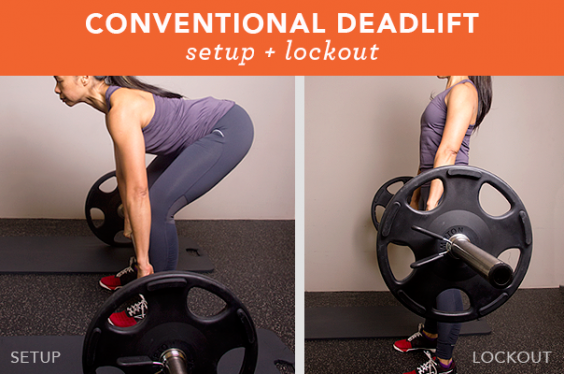
1. Stand with feet slightly wider than shoulder-width apart, toes pointing straight ahead or slightly outward (no wider than 11 and 1 o'clock). The balls of the feet should line up under the bar. How much weight to use is up to you, but it's best to start with a low weight or no weight at all until you feel comfortable with the move.
2. With knees slightly bent and hands gripping the bar slightly outside of legs, hinge forward from hips. Use a hook grip: When you place your hands on the bar, wrap your first two fingers over your thumb, sandwiched between your fingers and the bar. With the bar close to shins, keep head up, eyes looking forward, chest out, and back flat. Inhale.
3. Keeping the bar close to the body, exhale as you work to straighten the legs—drive through the heels, not the toes—and bring the weight up past knees. Keep core engaged throughout the entire movement (this helps protect the spine) and finish by thrusting the hips into alignment with the feet and squeezing your glutes. Constricting the butt muscles will complete the hip extension and bring the pelvis to a neutral position.
4. Once the bar is past the knees and the arms are straight, gently rest it against your thighs and maintain a straight back, without rolling shoulders back. You can pause here for a few seconds to add an isometric dimension to the exercise, which can help provide bigger strength gains .
5. Maintaining a straight back, slowly hinge forward at the hips (allow knees to bend a little at the same time) and lower the bar back to the ground. That's rep one.

Variations
 

Sumo Deadlift
    

Sumo Deadlift
Awaken your inner sumo wrestler with this exercise (traditional sumo attire optional). This deadlift variation has a wider stance than the conventional kind, and though it may be easier and feel more natural for some lifters, it actually requires more mobility (Need some work in the flexibility department? Good old stretching helps make us more limber, while foam-rolling can do wonders to increase flexibility.). Because of the wider stance (the feet are near the collars of the barbell, so shins are slightly past perpendicular to the bar), different muscles are targeted—the more the knees are bent, the more the quads, hip adductors, and glutes work. But if the deadlift is performed with straighter legs, the hamstrings and trap muscles work harder .
Trap Bar Deadlift
Research suggests the trap bar (aka hexagonal barbell) provides more range of motion in the hips than a straight barbell, which is, ya know, straight . This variation carries a much lower risk of the bar hitting the shins, and the body assumes more of a squat position than it does with the conventional deadlift. As a result, trap bars allow for significantly more quad activation than deadlifting with a straight bar, and lifters can usually pull more weight this way. This is a better variation for those with (or those who fear) lower-back injury because there's less loading on the spine. But if your ultimate goal is to achieve maximum back and hamstring engagement, then the conventional straight bar deadlift is a better choice.
Romanian Deadlift
Not just for the Romanians, this deadlift is performed with relatively straight legs — the knees are soft, but not bent nearly as far as they are during the conventional deadlift (as a result, the bar doesn't actually touch the ground in between reps). With this variation, the lower back bears a lot more weight, so be mindful of any pain or weakness in that area .
Clean-Grip Deadlift
Time to get down and dirty with the clean grip! This variation—often employed by Olympic lifters—requires a much deeper knee bend than most deadlifts. Like the trap bar deadlift, it's similar to a squat and targets the quads and glutes more than the hamstrings. But since it's performed with a regular barbell, there's a higher risk of scraping the shins when legs get tired, so pay careful attention and wear long socks or pants as a barrier. By squatting lower and keeping the chest more upright, this lift also puts slightly less strain on the lower back.
Snatch-grip deadlift
    
Snatch-Grip Deadlift
The snatch-grip deadlift is very similar to the clean-grip deadlift, but the grip is much wider. It should be as wide as feels comfortable, but start with a lower weight than you may use for a conventional deadlift, since this variation targets slightly different muscles, particularly in the upper back. Because of the wider hand placement, the hips end up lower than in a clean-grip (but aim to keep the shoulders higher than the hips and the hips higher than the knees from the start). Successful snatch-grip deadlifts may depend on heightened flexibility in the wrists and shoulders and can be more difficult for those with shorter arms.
Dumbbell deadlift
    
Dumbbell Deadlift 
Don't have access to a barbell? Try using dumbbells instead. The movement itself (and the muscles targeted) is very similar to the trap bar deadlift, since the weight can be positioned to the side of each leg. This move can be made more challenging by performing the movement single-legged.

The Most Common Mistakes and How to Fix Them

The Mistake: Keeping the bar too far away from the body.
The Fix: Keeping the barbell closer to the body while deadlifting may enhance performance and minimize injury risk . To ensure the bar is at a safe and comfortable position, roll it up as close to the shins and quads as possible without touching the body.
The Mistake: Rounding the back.
The Fix:
Assuming a hunchback is a recipe for deadlift disaster. While rounding the back may seem like a helpful strategy for lifting heavier weights, it's much safer to keep the spine neutral (which includes the head and neck). Note: Make sure not to hyper-flex the back at the end of the move (by letting your lower back dip), which can put undue force on the spine.
The Mistake: Pulling with the back.
The Fix: Rather than pull with the back and arms during a deadlift, push through the heels and force the hips forward until the bar is at knee level. As you raise the bar, work to thrust the hips until fully standing. This is a hip-dominant exercise; pulling the weight throughout the movement can strain the back, so emphasise thrusting the hips rather than yanking backward with the legs and shoulders.
The Mistake: Rolling the shoulders.
The Fix:
Rolling shoulders at the top of the lift can be pretty damaging—while shoulders are a super mobile joint, they aren't very stable—especially with heavy weights. Since our leg muscles can typically bear more weight than the upper body, drawing the shoulder blades together can put too much stress on the shoulders and upper back. Next time you take to the bar, make sure to thrust those hips at the top of the movement and work toward a neutral spine rather than a curved one. And when you're in the lockout, try not to pull your shoulders back or puff out your chest.
The Mistake: Starting the move with the hips too low.
The Fix: If the hips are too low during a conventional deadlift, the bar will probably smack into the shins and knees. Though most squats should be performed deep, the conventional deadlift does not require sitting super far back into the hips. The knees should bend just enough that the hands comfortably grip the bar without the back hunching.

The Takeaway

Deadlifts aren't easy to perfect, and it can be hard to keep track of the intricacies of the movement, especially when starting out. We recommend training with a partner or trainer who can keep an eye on your form, and it's never a bad idea to make a video recording of your deadlift to study later. Happy lifting!!
Deadlift


-- 
Would you like to be part of this segment? OR DO YOU WANT TO DONATE TO SUPPORT,??
Please contact us via our email: blog-apps@hotmail.com   for procedures to follow.
 Thanks for stopping by! Your feedback keeps me going. Do follow on  Twitter: @oatzeal
ALWAYS CHECK BACK FOR NEW POST, WE WILL ALWAYS UPDATE SOMETHING NEW EVERYDAY

Fitness 101: The Absolute Beginner's Guide to Exercise

You've decided it's time to start exercising. Congratulations! You've taken the first step on your way to a new and improved body and mind
"Exercise is the magic pill," says Michael R. Bracko, EdD, FACSM, chairman of the American College of Sports Medicine's Consumer Information Committee. "Exercise can literally cure diseases like some forms of heart disease. Exercise has been implicated in helping people prevent or recover from some forms of cancer. Exercise helps people with arthritis. Exercise helps people prevent and reverse depression."
trainer blowing a whistle
And there's no arguing that exercise can help most people lose weight, as well as look more toned and trim.
Of course, there's a catch. You need to get -- and keep -- moving if you want to cash in on the benefits. This doesn't necessarily mean following a strict, time-consuming regimen at the gym -- although that can certainly reap benefits. The truth is you can get rewards from many different types and levels of exercise.
"Any little increment of physical activity is going to be a great boost to weight loss and feeling better," says Rita Redberg, MSc, chairwoman of the American Heart Association's Scientific Advisory Board for the Choose to Move program.
Your exercise options are numerous, including walking, dancing, gardening, biking -- even doing household chores, says Redberg. The important thing is to choose activities you enjoy, she says. That will increase your chances of making it a habit.
And how much exercise should you do? For heart health, the AHA recommends at least 30 minutes of moderate-intensity physical activity, such as walking, on most days of the week.
Yet "if you're getting less than that, you're still going to see benefits," says Redberg. "It's not like if you can't do 30 minutes, you shouldn't do anything, because you're definitely going to see benefits even at 5 or 10 minutes of moving around."
Ready to get started? Health and fitness experts helped WebMD compile this beginner's guide to exercise, including definitions of some common exercise terms, sample workouts, and recommendations on home exercise equipment.
A way to measure the intensity of your exercise is to check you heart rate or pulse during physical activity. These should be within a target range during different levels of intensity.
For example, according to the CDC, for moderate-intensity physical activity, a person's target heart rate should be 50% to 70% of his or her maximum heart rate.

Get Ready

The first step to any workout routine is to evaluate how fit you are for your chosen physical activity. Whenever you begin an exercise program, it's wise to consult a doctor. Anyone with major health risks, males aged 45 and older, and women aged 55 and older should get medical clearance, says Cedric Bryant, PhD, chief exercise physiologist for the American Council on Exercise.


But no matter what your medical condition, you can usually work out in some way.
"I can't think of any medical issue that would get worse from the right kind of exercise," says Stephanie Siegrist, MD, an orthopedic surgeon in private practice in Rochester, N.Y.
After assessing your fitness, it helps to set workout goals. For example, do you want to prepare to run a 5K? Hit the gym five times a week? Or just walk around the block without getting winded?
"Make sure the goals are clear, realistic, and concise," says Sal Fichera, an exercise physiologist and owner of New York-based Forza Fitness.
Whatever your goals and medical condition, approach any new exercise regimen with caution.
"Start low and go slow," advises Bryant. Many beginners make the mistake of starting out too aggressively, only to give up when they end up tired, sore, or injured, he says. Some get discouraged because they think an aggressive workout will produce instant results.
"Generally speaking, when people go about it too aggressively early in the program, they tend not to stick with it over the long haul," says Bryant. "What you really want to do is to develop some new habits that you can stick with for a lifetime."

Fitness Definitions

Even long-term exercisers may have misconceptions about exactly what some fitness terms mean. Here are some definition of words and phrases you're likely to encounter:
  • Aerobic/cardiovascular activity. These are exercises that are strenuous enough to temporarily speed up your breathing and heart rate. Running, cycling, walking, swimming, and dancing fall in this category.
  • Maximum Heart Rate is based on the person's age. An estimate of a person's maximum age-related heart rate can be obtained by subtracting the person's age from 220.
  • Flexibility training or stretching. This type of workout enhances the range of motion of joints. Age and inactivity tend to cause muscles, tendons, and ligaments to shorten over time. Contrary to popular belief, however, stretching and warming up are not synonymous. In fact, stretching cold muscles and joints can make them prone to injury.
  • Strength, weight, or resistance training. This type of exercise is aimed at improving the strength and function of muscles. Specific exercises are done to strengthen each muscle group. Weight lifting and exercising with stretchy resistance bands are examples of resistance training activities, as are exercises like pushups in which you work against the weight of your own body.
  • Set. Usually used in discussing strength training exercises, this term refers to repeating the same exercise a certain number of times. For instance, a weight lifter may do 10 biceps curls, rest for a few moments, then perform another "set" of 10 more biceps curls.
  • Repetition or "rep." This refers to the number of times you perform an exercise during a set. For example, the weight lifter mentioned above performed 10 reps of the bicep curl exercise in each set.
  • Warm up. This is the act of preparing your body for the stress of exercise. The body can be warmed up with light intensity aerobic movements like walking slowly. These movements increase blood flow, which in turn heats up muscles and joints. "Think of it as a lube job for the body," Bryant explains. At the end of your warm-up, it's a good idea to do a little light stretching.
  • Cooldown. This is the less-strenuous exercise you do to cool your body down after the more intense part of your workout. For example, after a walk on a treadmill, you might walk at a reduced speed and incline for several minutes until your breathing and heart rate slow down. Stretching is often part of a cooldown.


Sample Workouts for Beginners

Before beginning any fitness routine, it's important to warm up, then do some light stretching. Save the bulk of the stretching for after the workout.
Once you're warmed up, experts recommend three different types of exercise for overall physical fitness: cardiovascular activity, strength conditioning, and flexibility training. These don't all have to be done at once, but doing each on a regular basis will result in balanced fitness.
  • Cardiovascular activity. Start by doing an aerobic activity, like walking or running, for a sustained 20-30 minutes, four to five times a week, says Bryant. To ensure you're working at an optimum level, try the "talk test": Make sure you can carry on a basic level of conversation without being too winded. But if you can easily sing a song, you're not working hard enough.
  • Strength conditioning. Start by doing one set of exercises targeting each of the major muscle groups. Bryant suggests using a weight at which you can comfortably perform the exercise eight to 12 times in a set. When you think you can handle more, gradually increase either the weight, the number of repetitions, or number of sets. To maximize the benefits, do strength training at least twice a week. Never work the same body part two days in a row.
  • Flexibility training. The American College on Exercise recommends doing slow, sustained static stretches three to seven days per week. Each stretch should last 10-30 seconds.
To learn how to perform certain exercises, consider hiring a personal trainer for a session or two, or take advantage of free sessions offered when you join a gym.

Home Exercise Equipment

Exercise doesn't have to be done at the gym. You can work out in the comfort of your own home. And with calesthenic-type exercises such as squats, lunges, pushups, and sit-ups, you can use the resistance of your own weight to condition your body. To boost your strength and aerobic capacity, you may also want to invest in some home exercise equipment.
Experts offer their thoughts on some popular home exercise items:
  • Treadmill. This best-selling piece of equipment is great for cardiovascular exercise, says Bracko. He recommends starting out walking at a low intensity for 30 minutes and applying the talk test. Depending on how you do, adjust the intensity, incline, and/or time accordingly.
  • Free weights. Barbells and dumbbells make up this category of strength-training equipment. Dumbbells are recommended for beginners. Fichera suggests purchasing an 18 pound adjustable dumbbell set, which can be adjusted in 3 pound increments.
  • Other strength training equipment. This includes weight stacks (plates with cables and pulleys), flexible bands, and flexible rods. Fichera says flexible bands are good for beginners, especially since they come with instructions. But he doesn't recommend them for long-term use; your muscles will likely adapt to the resistance and need more of a challenge.
  • Exercise ball. Although instructions and/or a companion video can accompany this gadget, Bracko worries that beginners may use exercise balls improperly. "Some people fall off or can't keep the ball still," he says. But if you enjoy working out with an exercise ball, it can provide a good workout.
  • Exercise videos and DVDs. Before working out with a home exercise video or DVD, Siegrist recommends watching through it at least once to observe the structure and proper form of the workout. To further improve form, she suggests working out in front of a mirror, if possible, or having someone else watch you do the exercise.


-- 
Would you like to be part of this segment? OR DO YOU WANT TO DONATE TO SUPPORT,??
Please contact us via our email: blog-apps@hotmail.com   for procedures to follow.
 Thanks for stopping by! Your feedback keeps me going. Do follow on  Twitter: @oatzeal
ALWAYS CHECK BACK FOR NEW POST, WE WILL ALWAYS UPDATE SOMETHING NEW EVERYDAY


After-School Exercise Yields Brain Gains: Study

appears to improve children's attention and multi-tasking skills, according to a new study.
Elementary school-age students who participated in an after-school program with plenty of physical activity showed greater improvements in several areas of so-called "executive function" than similar students who did not participate.
Executive function refers to a range of mental or "cognitive" skills that include memory, focus, attention and the ability to switch back and forth between tasks.
Lead researcher Charles Hillman said that students who had the highest attendance in the program saw the biggest gains in mental skills.
"I think these are the hardest evidence we have available that time spent in physical activities, which would include physical education and recess, not only doesn't detract from academic goals, but it might enhance academic performance," said Hillman, a professor of kinesiology and community health at the University of Illinois at Urbana-Champaign.
The findings were published online Sept. 29 and in the October print issue of the journal Pediatrics.
The researchers randomly assigned 221 children, aged 7 to 9, to either the after-school program or a wait-list for the program. The after-school program occurred for nearly all of the school year (150 days). Over two hours, physical aactivity alternated with rest periods, resulting in about 70 minutes of moderate to vigorous exercise every weekday, Hillman said.
The children took tests to measure their "inhibition" and their "cognitive flexibility," which is basically their ability to switch between different tasks successfully, such as reading something and then answering questions about that reading, Hillman said.
Inhibition involves two types of thinking skills, Hillman explained: the ability to ignore distractions in the environment to focus on something specific, and the ability to stop a well-learned response quickly when necessary.
If a child automatically starts to ride his bicycle across a street when a light turns green, for example, a strong inhibition response refers to how quickly he can prevent himself from going forward when he notices a car running the red light.
Although children in both the after-school program and the wait-list group experienced improvements in physical fitness, inhibition and cognitive flexibility, the after-school program participants made bigger gains in all three areas.
The program participants also showed improvements in attention that were not seen in the wait-list group, and they had smaller gains in body mass index (BMI) than the wait-list students. BMI is a measurement of body fat based on height and weight.
Because the study directly compared two similar groups of children, the findings support the idea that the physical activity actually caused the brain improvements, though it's less clear how physical activity improves thinking skills, the experts said

"From a brain structure perspective, we know that regions of the brain gain volume with fitness intervention from studies with older adults," Hillman said, though that does not mean increased volume leads to better thinking.
Meanwhile, other studies have found changes in the way neurotransmitters work in the brain after physical activity, and how exercise affects the hippocampus, the part of the brain responsible for memory and learning, he said.
Most likely, Hillman said, several different mechanisms are at work in the brain that allow physical activity to improve mental abilities.
The study was well-designed, according to an expert who was familiar with the findings.
Nathaniel Riggs, an associate professor of human development and family studies at Colorado State University in Fort Collins, said, "One important direction for future research is to actually measure physiological processes that may be able to explain these associations."
Riggs pointed out that the study even compared the results of children in different groups who had been matched in terms of age, sex, race/ethnicity and socioeconomic status. One of the only weaknesses of the study is the inability to know how long the mental gains from the exercise might last, he said.
But executive control -- the collection of mental skills that got a boost from the exercise -- is critical for positive development, Riggs added.
"It's actually more strongly correlated with academic achievement than is IQ," he said. "The policy implication is that schools will want to consider providing increased opportunities for physical activity to their students not only to promote better health, but also to potentially increase academic achievement."
The benefits could extend even beyond academic success, Riggs said.
"Executive control is also associated with fewer conduct problems, which can interfere with classroom instruction, less drug use, which interferes with learning, and less risky sexual behavior, which can result in school drop-out due to unintended pregnancies," he said.
The study was funded by the U.S. National Institute of Child Health and Human Development and the National Institutes of Health.

-- 
Would you like to be part of this segment? OR DO YOU WANT TO DONATE TO SUPPORT,??
Please contact us via our email: blog-apps@hotmail.com   for procedures to follow.
 Thanks for stopping by! Your feedback keeps me going. Do follow on  Twitter: @oatzeal
ALWAYS CHECK BACK FOR NEW POST, WE WILL ALWAYS UPDATE SOMETHING NEW EVERYDAY

Hello